As Hemolife continues its mission to bridge critical gaps in blood donation systems across the Global South, 2025 emerged as a pivotal year, one that turned early momentum into tangible impact across communities, campuses, and health institutions.
Blood shortages continue to threaten lives worldwide, and in the midst of this reality, Hemolife has steadily grown into more than an app. It has become a community-powered, tech-driven movement focused on one clear mission: ensuring that no life is lost due to a lack of blood.
Here, we reflect on Hemolife’s journey through 2025 and where we are boldly headed in 2026.
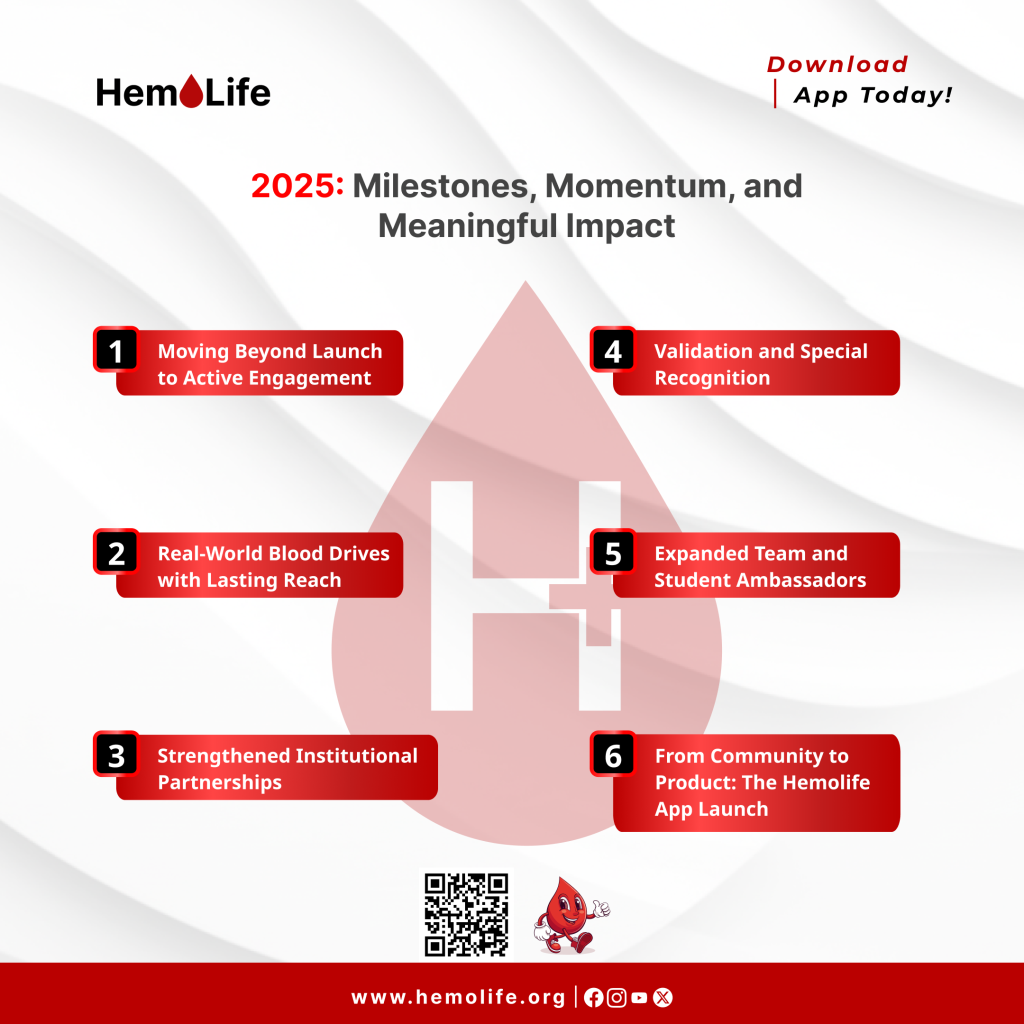
2025: Milestones, Momentum, and Meaningful Impact
1. Moving Beyond Launch to Active Engagement
The early progress in 2024, when we unveiled the official Hemolife website and social media channels and reached 1,000+ combined followers, served as a launchpad for deeper engagement in 2025.
This year, the focus shifted from presence to purpose-driven interaction:
- Consistent awareness and education campaigns around blood donation
- Growth in digital community participation
- Stories and conversations that encouraged voluntary donations across regions
And ultimately, we launched the Hemolife App.
2. Real-World Blood Drives with Lasting Reach
In 2025, Hemolife supported and mobilised several blood donation drives, especially within tertiary institutions and youth communities.
These drives revealed a powerful truth:
Young people are willing to donate blood when education, trust, and access are prioritised.
A major highlight was the World Sickle Cell Awareness Month Blood Drive, which reached over 565+ individuals through awareness, screening, and safe donation processes in collaboration with medical professionals.
Our work with AIESEC in Jos further helped us reach 200+ students with the Hemolife gospel. Through additional collaborations and activations, we directly reached over 3,000 individuals, collected more than 200 pints of blood, and freely distributed them to hospitals and blood banks, saving over 600 lives in the process.
Beyond the numbers, these drives helped us:
- Normalise voluntary blood donation
- Correct long-standing myths around donation
- Create repeat donors, not one-time participants
3. Strengthened Institutional Partnerships
Strategic partnerships remain central to Hemolife’s model.
In 2025, we partnered with organisations including:
- Jos University Medical Students’ Association (JUMSA)
- Department of Haematology, Jos University Teaching Hospital (JUTH)
- National Blood Service Agency (NBSA)
- AIESEC in Jos
These collaborations expanded the reach and medical integrity of our programs, creating pipelines for sustainable donor support systems, relationships we intend to deepen even further in 2026.
4. Validation and Special Recognition
2025 also brought meaningful validation of our work.
- Participated as a delegate at the Africa Health Business International Conference in Abuja, following an invitation from the Coalition for Blood for Africa (COBA)
- Emerged as a finalist at the iHatch North Central Regional Pitch Competition
- Became a finalist at the Policy Innovation Centre’s inaugural Pitchathon, placing in the top 6 out of 400+ applications
Across these platforms, we shared Hemolife’s story with a combined audience of 2,500+ stakeholders, receiving strong validation and support for our mission.
5. Expanded Team and Student Ambassadors
The Hemolife Student Ambassador Program became a key driver of grassroots mobilisation in 2025.
This year, we expanded to 40 ambassadors, and we remain deeply grateful to each one of them.
Our ambassadors:
- Led campus-level awareness campaigns
- Helped organise blood drives and outreach events
- Served as local advocates for a culture of voluntary blood donation
Once again, this reaffirmed the power of peer leadership in public health impact.
6. From Community to Product: The Hemolife App Launch
September 2025 marked a defining milestone in our journey: the official launch of the Hemolife App.
After months of community engagement, pilot testing, and feedback-driven iteration, the app was released as a practical tool connecting donors, hospitals, and urgent blood needs.
The launch marked a shift from concept to execution, enabling:
- Peer-to-Peer donor–recipient matching
- Appointment scheduling for routed blood donations
- The first step toward an incentivised donation model
- MeeChat, our AI health assistant
- Improved coordination during blood drives and emergencies
- Stronger data visibility for planning and response
Rather than replacing our community model, the app strengthened it- adding structure, speed, and reliability to work already happening on the ground.
This launch reaffirmed a core belief behind Hemolife:
Technology is most powerful when it amplifies human compassion.
Key Lessons from 2025
- Trust drives adoption– community trust enabled successful app uptake
- Offline impact fuels online tools– blood drives informed product design
- Launch is a milestone, not the finish line
The September 2025 app launch closed one chapter and opened another.
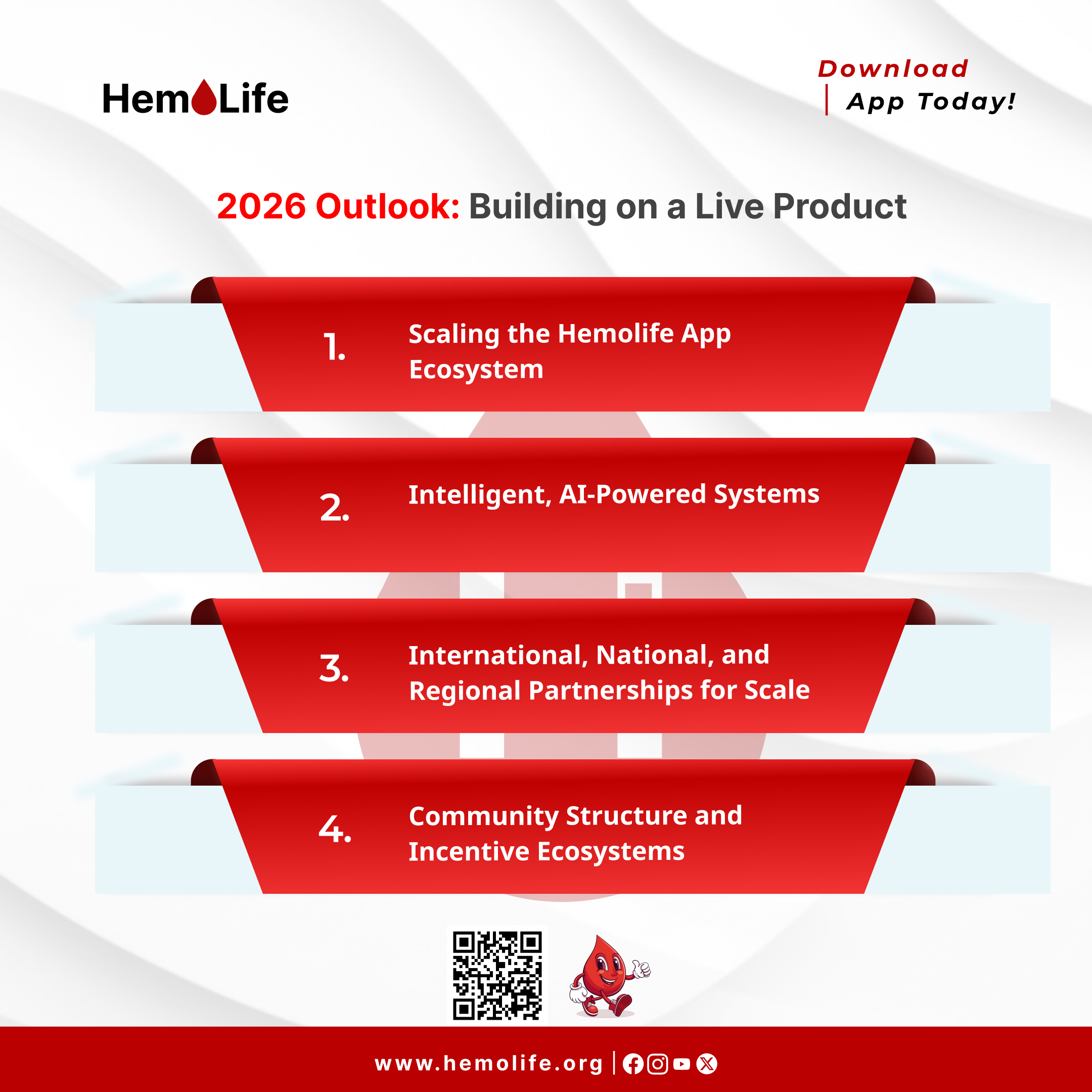
2026 Outlook: Building on a Live Product
1. Scaling the Hemolife App Ecosystem
With the app now live, 2026 will focus on scaling adoption and deepening functionality, including:
- Expanded donor–hospital onboarding
- Improved emergency alert flows
- Enhanced donation tracking and user experience
- User acquisition campaigns
- Incentivised participation models
- Clear business and sustainability frameworks
The emphasis shifts from launch to usage, retention, and measurable impact.
2. Intelligent, AI-Powered Systems
One of the most exciting pivots for 2026 is the integration of AI into core platform capabilities:
- Predictive modelling to anticipate blood demand spikes
- Smart matching between donor availability and hospital needs
- Blockchain integration for haemovigilance and traceability
These tools are designed to reduce response times and enable proactive, data-driven donor mobilization.
3. International, National, and Regional Partnerships for Scale
In 2026, Hemolife aims to expand institutional integration by:
- Deepening collaboration with hospitals and health agencies at the national scale
- Partnering with NGOs and community health organisers
- Building regional blood availability dashboards
- Exploring additional funding models
- Activating 12 campuses and executing large-scale blood drives
These partnerships will strengthen coordination across the healthcare ecosystem.
4. Community Structure and Incentive Ecosystems
Hemolife plans to formalise participation through:
- Verified donor histories and recognition badges
- Ambassador leadership tiers and pathways
- Impact dashboards for hospitals and strategic partners
By celebrating donors and ambassadors with verifiable impact records, Hemolife fosters sustained participation rather than one-off engagement.
Conclusion: From Takeoff to Lifelong Impact
Reflecting on 2025, Hemolife didn’t just take flight; it began shaping the infrastructure of a lifesaving movement.
What started with foundational achievements in 2024 and steady activations in 2025 now evolves into an era of smart, AI-driven impact, designed to meet real human needs at scale.
As 2026 unfolds, our mission becomes clearer in both ambition and execution:
To ensure that when someone needs blood, it’s available, swiftly, safely, and with dignity.
Because every pint truly counts.